Princeton IT Services
Resources / Blogs
Oracle Apiary and Oracle API Platform-as-a-service by Lakshman Bulusu
Oracle Apiary is an API-first solution for design, development, testing, and documentation of application programming interfaces.

Oracle API Platform Cloud Service is a state-of-the-art P-a-a-S for API-First design and management that enables centralized design and implementation of the full API life cycle from design and standardization to documenting, publishing, testing, governance, and administration of APIs from the Oracle Cloud. It provides the ability to use APIs to gain access to business information from data to digital vaults in a transparent manner by way of tracking user access and security of the APIs. The latest version of Oracle API Platform-as-a-service is 20.3.3 (as of September 2020).
API-first Development also called Design-first Development is where APIs are built before applications and then get contract-sign-on with potential customers. Then these APIs can be tested and registered for use/consumption.
Read about: AWS – Database Migration Service – Wildcard Include and Exclude Table
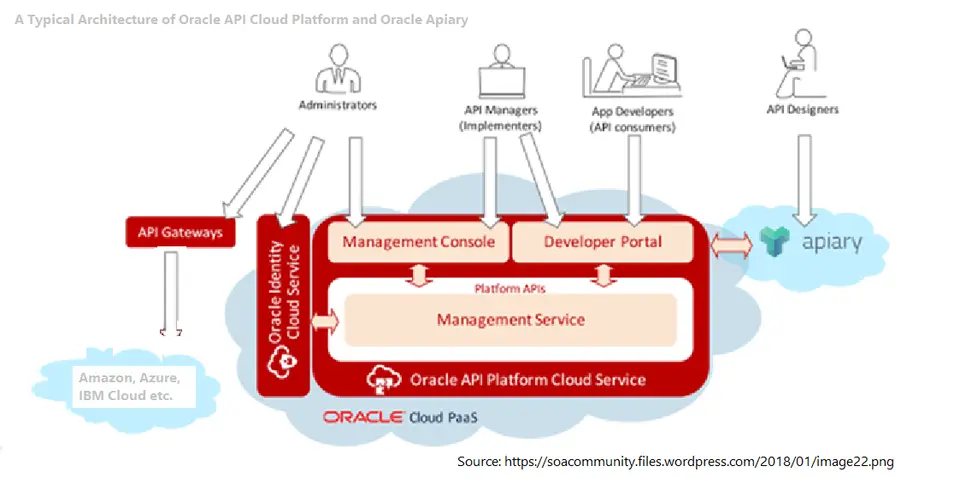
Oracle Apiary is an API-first solution for design, development, testing, and documentation of application programming interfaces (APIs) that share business services and data using API Blueprint (Apiary’s own API design notation) and OpenAPI (Swagger 2.0) industry standards. Oracle Apiary serves as the front-end solution for the design-to-governance of APIs. Oracle API Platform Cloud Service incorporates Oracle API Developer Portal that is liked with Oracle Apiary with the and Oracle Identity Cloud Service as its components. And API gateways as engines that run the APIs are deployed in any cloud (i.e. Amazon, Azure, Oracle Cloud, IBM Cloud, etc) and/or on-premises.
Oracle Apiary enables auto-generated documentation and interactive console from the API Blueprint or Swagger 2.0 description files to consume the API via calls from the UI.
Key features of Oracle API Platform Cloud Service as of the latest release are:
1. Allows API Application access restriction based on resources endpoints
2. Allows Request Payload Validation policies of methods exposed by REST endpoints
3. Allows Query parameters to be passed in the form “?param” or “?param=val” that get forwarded to the service request.
4. Enables Oracle Identity Cloud Service federated single sign-on for Developer Portal
The following figure depicts a typical architecture of Oracle API Platform Cloud Service.
The primary steps for using Oracle Apiary within Oracle API Platform Cloud Service for an implementing API using the API-First approach are:’
1. Create an API in Apiary
2. Creating an API in Oracle API Platform Cloud Service
3. Configuring the API Request Endpoint
4. Configuring the Service Request URL
5. Apply policies
6. Add overview and documentation text
7. Deploying the API to a Gateway
8. Invoking the API at Runtime
9. Documenting the API
10. Publish the API to the Developer Portal
11. Consume/Subscribe an Application to the API
A detailed explanation of these steps including how to use Oracle API Platform Cloud Service can be found here. An real-world example of implementing APIs in Oracle API Platform Cloud Service can be found here.
The Oracle Apiary tool can also be used to perform these steps and add Oracle Apirary documentation to an API as well as link an Oracle Apiary specification to an API.
To start using Oracle Apiary, go to here. A real-world example of creating an API using Oracle Apiary can be found here. And an example of documenting this API (and publishing it to the Developer portal) can be found here.
Complete information on Oracle API Platform Cloud Service and its Developer portal (integrated with Oracle Apiary) with examples can be found here.
Two key aspects of Oracle API Platform Cloud Service vis-a-vis Oracle Apiary) are:
1. Using the Management portal to apply policies to APIs
2. Using the Development portal to discover APIs powered by API catalog and subscribing applications to consume APIs

 Automated, tested migration