 Princeton IT Services
Resources / Blogs
AI Hallucination in Multi-Agent Systems: The Hidden Risk in Enterprise Workflows
AI hallucination in multi-agent systems can spread errors across workflows. Learn risks, causes, and how to prevent failures in enterprise AI.
The Hallucination Problem in Multi-Agent AI Systems
Enterprises are increasingly deploying multi-agent AI systems not just to answer questions, but to act—reading documents, extracting obligations, routing decisions, and drafting outputs across departments. The value is clear: faster workflows, fewer bottlenecks, and consistent execution at scale.
But as these systems grow more autonomous and interconnected, a critical issue emerges—the AI hallucination problem. It doesn’t trigger alerts or errors. It simply produces incorrect outputs with complete confidence, making it one of the most serious enterprise AI risks today.
What is AI Hallucination?
AI hallucination occurs when models generate responses that sound accurate but are factually incorrect, unsupported, or fabricated. This is a known limitation in large language models (LLMs), which power most modern AI agents.
There are two primary types:
Since LLMs predict language patterns rather than verify truth, LLM hallucination remains a persistent AI reliability issue, even in well-defined workflows.
Why Multi-Agent AI Systems Amplify the Problem
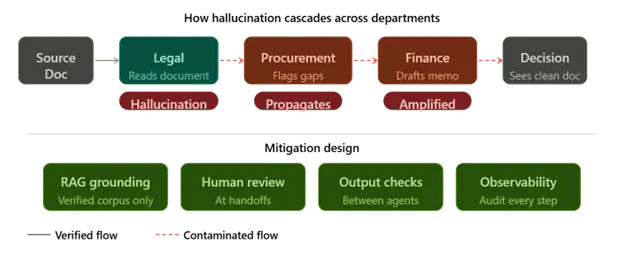
In multi-agent AI architecture, outputs are chained. One agent’s response becomes the next agent’s input.
This creates a system where:
- Errors are treated as verified facts
- No agent questions upstream outputs
- Hallucinations propagate silently
A single incorrect detail—such as a fabricated clause or misinterpreted figure—can cascade across the system. This is the core risk of hallucination in multi-agent systems.
Over time, this leads to:
- Compounded AI decision errors
- Increased AI misinformation generation
- Reduced trust in automated workflows
The Enterprise Document Workflow Risk
In enterprise environments, AI agents are often embedded in document workflows across Legal, Finance, Procurement, and Risk.
Each function assumes the previous one has validated the data:
- Legal trusts financial inputs
- Finance trusts contractual accuracy
- Risk trusts compliance checks
If an early-stage hallucination occurs, it moves through the system unchecked. This results in large-scale AI document processing errors that appear credible and authoritative.
Without strong enterprise AI governance, these failures remain invisible until they create real business impact.
What Good Design Looks Like
Mitigating the AI hallucination problem requires deliberate system design, not reactive fixes.
- Grounding with Verified Sources
Using retrieval augmented generation (RAG) ensures outputs are tied to real documents rather than model assumptions.
- Validation Layers Between Agents
Introduce checkpoints to verify outputs before passing them forward in multi-agent AI systems.
- Human-in-the-Loop Controls
For critical workflows, human-in-the-loop AI ensures that high-risk decisions are reviewed before execution.
- Observability and Traceability
Implement AI observability to track how outputs are generated, what sources are used, and where errors originate.
Final Thought
The hallucination problem in AI systems is not a rare edge case—it is a structural limitation.
In multi-agent AI systems, this limitation becomes more dangerous because errors don’t stop—they spread.
Organizations that prioritize validation, grounding, and oversight as core architecture—not afterthoughts—will be the ones that scale AI with confidence and control.
References
- Ji, Z., Lee, N., Frieske, R., et al. (2023). Survey of hallucination in natural language generation. ACM Computing Surveys, 55(12), 1–38.
- Huang, L., Yu, W., Ma, W., et al. (2023). A survey on hallucination in large language models: Principles, taxonomy, challenges, and open questions. arXiv:2311.05232.
- Lewis, P., Perez, E., Piktus, A., et al. (2020). Retrieval-augmented generation for knowledge-intensive NLP tasks. NeurIPS 2020.
- Maynez, J., Narayan, S., Bohnet, B., & McDonald, R. (2020). On faithfulness and factuality in abstractive summarization. ACL 2020.
- Wu, Q., Bansal, G., Zhang, J., et al. (2023). AutoGen: Enabling next-gen LLM applications via multi-agent conversation. arXiv:2308.08155.
 Hours of daily filing down to minutes