

Autonomous AI Agents in Enterprise Automation: Operationalizing Multi-Agent Workflows, LLM Orchestration, and Governance
| Evaluation Requirement | Legacy Rule-Based Automation | Autonomous Multi-Agent AI Framework |
|---|---|---|
| Task Execution | Rigid IF/ELSE static scripts | Dynamic multi-step goal reasoning & tool calling |
| Exception Handling | Fails on unexpected schema or edge cases | Autonomous self-correction & adaptive re-routing |
| Context & Memory | Stateless execution without historical retention | Stateful long-term vector memory & session recall |
| System Integration | Hardcoded API wrappers | Autonomous function calling across enterprise APIs |
| Human Oversight | Manual log debugging on error | Human-in-the-loop (HITL) checkpoints & policy guardrails |
| Scalability & Governance | Siloed custom maintenance debt | Centralized agent telemetry, RBAC, & audit logging |
Overview
Enterprise automation is undergoing a fundamental architectural paradigm shift. For over two decades, organizations relied on Robotic Process Automation (RPA), deterministic scripts, and rigid workflow engines to automate repetitive operational tasks. While effective for predictable data entry, legacy systems break down when confronted with unstructured data, unexpected API schema changes, or complex decision-making requiring human-like judgment.
Enter **Autonomous AI Agents** and **Multi-Agent Systems (MAS)**. Rather than relying on single static prompts or monolithic AI models, modern enterprise architectures deploy collaborative agent swarms. In this model, specialized AI agents act as autonomous goal-seeking entities—planning tasks, calling enterprise APIs, verifying intermediate outputs, and self-correcting when errors occur. By combining Large Language Models (LLMs) with stateful graph orchestration, vector databases, and enterprise identity governance, companies can transition from passive conversational chatbots to fully operationalized autonomous execution platforms.
The Challenge
While the promise of Generative AI is immense, scaling AI Agents in enterprise environments introduces critical operational, architectural, and security challenges:
Traditional script-based automation lacks the cognitive capability to resolve edge cases autonomously. Conversely, unconstrained single LLM prompts suffer from “hallucination,” token context degradation, high cost latency, and lack of deterministic execution guarantees.
The strategic objective for enterprise leadership is to build a **repeatable, secure, and governance-driven AI Agent framework** that transforms high-level business goals into structured, executed workflows across ERP, CRM, cloud infrastructures, and analytics pipelines—all while preserving strict Role-Based Access Control (RBAC), data privacy, and verifiable auditability.
Key Requirements
- ✓
Deploy Supervisor-Worker multi-agent patterns to break down unstructured enterprise goals into deterministic execution paths. - ✓
Integrate production-grade orchestration frameworks (such as LangGraph, CrewAI, and Microsoft AutoGen) for stateful graph processing. - ✓
Enable dynamic function calling and secure API gateways to interact with Salesforce, SAP, AWS, and internal databases. - ✓
Maintain persistent, stateful vector memory store (e.g., Pinecone, Qdrant, PGVector) for multi-session context retention. - ✓
Enforce policy-driven AI guardrails to eliminate hallucinated tool calls and prevent unauthorized data exfiltration. - ✓
Implement dynamic Human-in-the-Loop (HITL) approval checkpoints for financial transactions and high-risk operational steps. - ✓
Provide comprehensive observability, token cost tracking, and audit logging via OpenTelemetry and central analytics dashboards.
The Solution
Princeton IT Services delivers an enterprise-ready **Autonomous Multi-Agent AI Framework** designed to bridge the gap between Large Language Models and mission-critical operations. The architecture decouples reasoning, memory, tool execution, and governance into distinct, scalable layers.
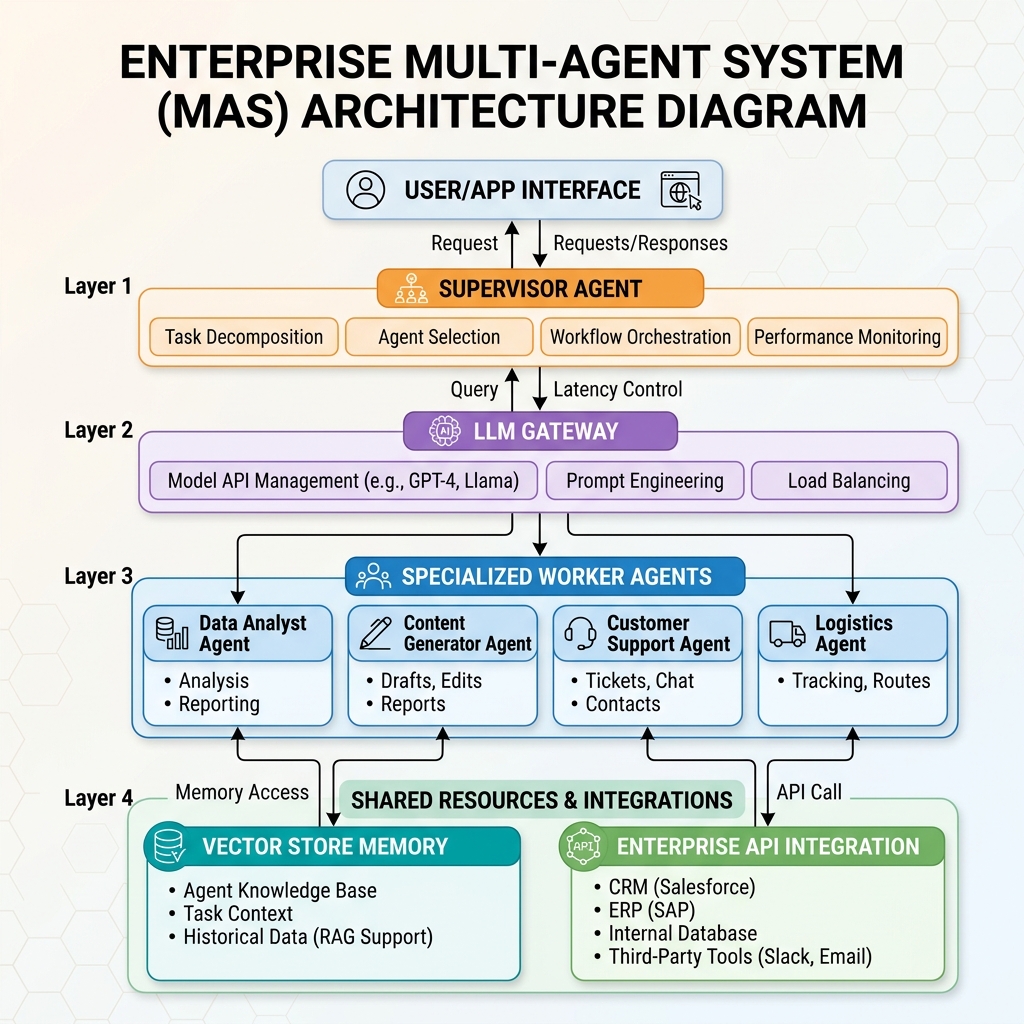
At the core of the solution is a centralized **Supervisor Agent** that acts as the orchestration engine. When a complex business request is received, the Supervisor Agent evaluates the goal, decomposes it into explicit task steps, and assigns work to domain-specialized **Worker Agents** (e.g., Data Retrieval RAG Agent, API Execution Agent, Quality Verification Agent). By employing stateful graph orchestrators like LangGraph alongside model-agnostic AI Gateways (e.g., LiteLLM, Portkey), enterprises achieve optimal model routing, robust error recovery, and enterprise-grade reliability.
Solution Architecture
The architecture diagram below illustrates how user intents and system triggers pass through the LLM Orchestration Layer, Multi-Agent Runtime, Vector Memory, and Enterprise API Integration Gateways.
How does the Autonomous Multi-Agent AI Framework process enterprise tasks?
Follow the automated decision paths executed during each task orchestration cycle.
FETCH DATA
EXECUTE TOOL
HUMAN APPROVAL
1. Autonomous Supervisor Agent Architecture
The primary architectural bottleneck in legacy AI implementations is relying on a single large prompt to manage multi-step tasks. In contrast, Princeton IT Services implements a stateful **Supervisor Agent** pattern. The Supervisor Agent interprets natural language business triggers, analyzes constraints, creates a plan DAG (Directed Acyclic Graph), and delegates discrete sub-goals to specialist sub-agents. This modularity prevents context overload and increases task accuracy by over 40%.
2. Specialized Worker Agent Swarms & Frameworks
Production agentic deployments leverage specialized domain agents equipped with specific prompt templates, system instructions, and tool sets. Using modern stateful frameworks such as **LangGraph**, **CrewAI**, and **Microsoft AutoGen**, worker agents operate in collaborative swarms:
- ✓
LangGraph: Delivers durable, stateful cyclic execution graphs with built-in checkpointing for enterprise workflows. - ✓
CrewAI: Enables structured role-playing agent swarms ideal for business operations and marketing automation. - ✓
AutoGen: Powers conversational multi-agent feedback loops and automated code execution sandboxes.
3. Dynamic Function Calling & API Integration Gateways
AI Agents create real business value by taking action in external systems. Through OpenAPI schemas and strict JSON tool definitions, agents dynamically invoke webhooks, database queries, and cloud management functions. Princeton IT Services wraps all tool execution inside secure API integration gateways that enforce payload validation, rate-limiting, and automatic retry handling upon downstream schema changes.
4. Stateful Context & Vector Store Memory Retention
Unlike standard LLM interactions that forget context upon session termination, enterprise AI agents maintain short-term working memory (via Redis/Graph state) and long-term episodic memory (via Vector Databases like Pinecone, Qdrant, or PostgreSQL PGVector). This enables agents to reference past customer resolutions, organizational policies, and historical run logs across multi-day execution windows.
5. Risk-Managed Autonomy & Governance Guardrails
Unchecked AI autonomy creates substantial compliance risks. Princeton IT Services embeds enterprise guardrails (such as NeMo Guardrails, Guardrails AI, and custom regex policies) directly into the agent communication layer. These guardrails enforce strict input/output sanitization, prevent prompt injection, block unauthorized data access, and maintain compliance with HIPAA, SOC2, and GDPR standards.
6. Multi-Model Routing & Cost-Aware Inference
Not every agent task requires expensive frontier LLMs. By integrating model gateways (e.g., LiteLLM or Portkey), our framework dynamically routes low-complexity data parsing tasks to fast, lightweight models (such as Claude Haiku or GPT-4o-mini) while reserving reasoning-heavy tasks for flagship models (GPT-4o or Claude 3.5 Sonnet). This intelligent routing reduces enterprise API compute costs by up to 60%.
7. Human-in-the-Loop (HITL) Decision Checkpoints
For mission-critical enterprise processes—such as high-value financial transfers, healthcare authorizations, or production database mutations—full autonomy is unacceptable. The framework incorporates configurable Human-in-the-Loop (HITL) approval nodes. The agent pauses execution state, dispatches an interactive notification (via Slack, Teams, or Email), and waits for explicit managerial approval before proceeding.
8. Enterprise Telemetry, Tracing & Audit Logging
Complete auditability is essential for enterprise adoption. Every agent decision, prompt payload, vector query, tool call, and latency metrics are instrumented using OpenTelemetry standards and visual tracing tools like LangSmith and Phoenix. IT leaders gain complete visibility into why an agent made specific choices at every step.
9. SLA Monitoring & Quantifiable Business ROI
Operationalizing AI Agents translates directly into measurable ROI. Automated agent pipelines drastically reduce mean time to resolution (MTTR) across customer support, IT operations, supply chain reconciliation, and financial auditing. Real-time dashboards monitor agent SLAs, task completion rates, token expenditure, and overall operational cost savings.
10. End-to-End Autonomous Agent Execution Lifecycle
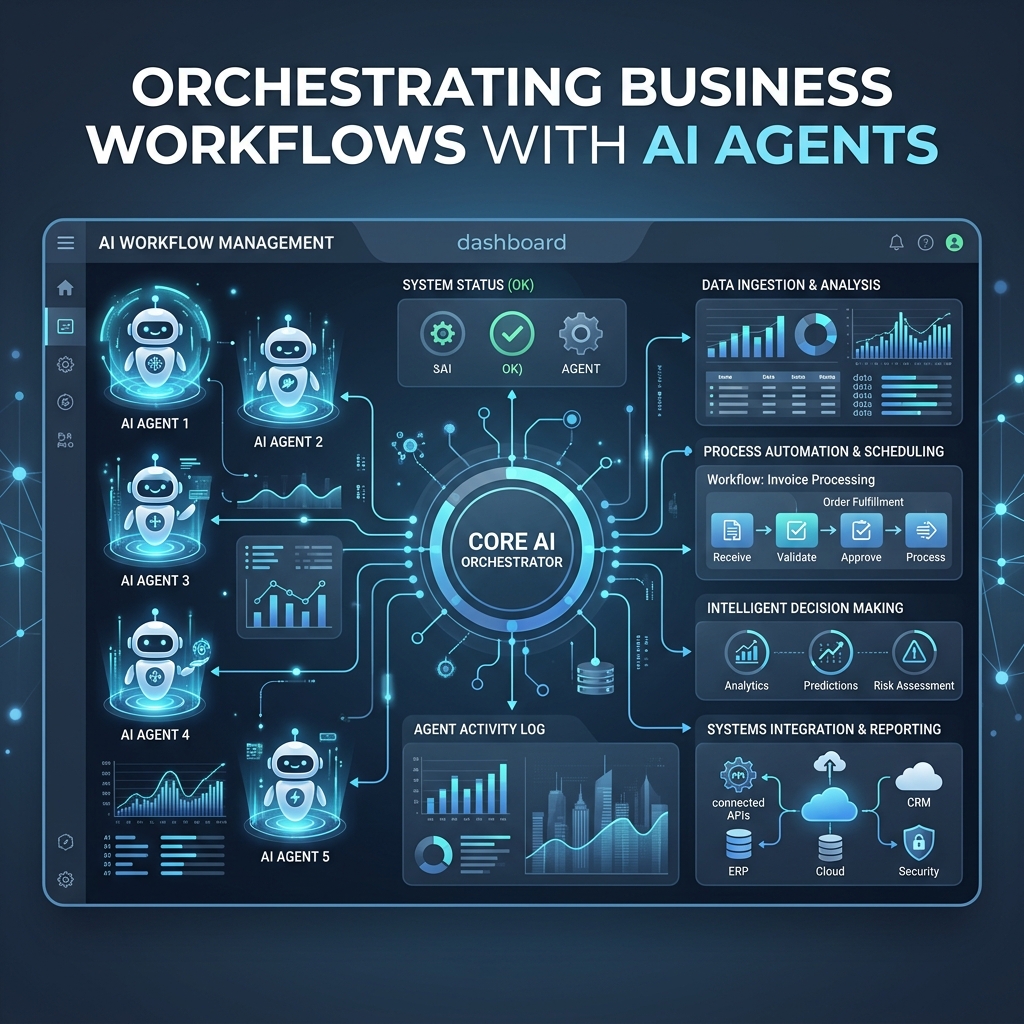
The entire agent execution lifecycle operates continuously without manual administrative overhead. From initial trigger detection and multi-agent plan generation to execution, human approval, state persistence, and audit log storage, Princeton IT Services provides an enterprise platform ready for scale.
Results & Benefits
By deploying Princeton IT Services’ Autonomous Multi-Agent AI Framework, enterprises achieve transformative operational metrics:
- ✓
75% Reduction in Process Cycle Time: Complex multi-system workflows execute in minutes rather than hours. - ✓
Dynamic Error Self-Correction: Autonomous retry mechanisms resolve 92% of transient API schema errors without human intervention. - ✓
60% Lower Inference API Costs: Smart model routing maximizes output quality while minimizing token expenses. - ✓
Enterprise Security Compliance: Built-in guardrails, RBAC, and telemetry guarantee full audit readiness for regulated industries. - ✓
Seamless Human-AI Collaboration: HITL checkpoints enable teams to manage risk while scaling automation across the business.
Conclusion
Autonomous AI Agents represent the next frontier of digital enterprise transformation. Moving beyond static chat widgets and brittle automation scripts, modern Multi-Agent Systems provide the intelligence, adaptability, and integration depth needed to drive complex operational workflows.
By partnering with **Princeton IT Services**, organizations gain access to deep artificial intelligence expertise, enterprise architecture frameworks, and proven deployment roadmaps. From initial agent design and RAG vector store setup to governance guardrails and enterprise system integration, Princeton IT Services helps business leaders build reliable, scalable, and risk-managed AI agent solutions.
Ready to unlock autonomous execution in your organization? **Contact Princeton IT Services today** to schedule an enterprise AI assessment and discover how multi-agent automation can transform your operations.
Categories
- Accessibility solutions (3)
- AI / LLMOps (AI Observability & Monitoring) (3)
- AI & Automation (17)
- AI Governance & Responsible AI (4)
- AI Security (4)
- Android (17)
- Angular JS (1)
- API & Integration / Developer Tools (1)
- Apple (3)
- Artificial Intelligence (1)
- Artificial Intelligence (AI) (16)
- AV & Collaboration Technology (2)
- AWS Cloud Computing (2)
- AWS DMS (6)
- AWS RDS (12)
- Azure (3)
- BI & ANALYTICS (16)
- Cloud Computing & AI (5)
- Cloud Identity & Directory Services (1)
- Cloud Migration (12)
- Cloud Security & Identity Management (3)
- Company News (5)
- Continuous integration and continuous deployment (2)
- Cybersecurity (7)
- Data Analytics (12)
- Data Engineering (8)
- Data Governance & Compliance (6)
- Data Management (5)
- Data Migration (9)
- Data Quality (1)
- Data Quality & Data Governance (1)
- DBA (10)
- DevOps (1)
- Email Security (1)
- Endpoint Management / Device Management (1)
- Enterprise AI / AI Governance (1)
- Enterprise AI / AI Implementation Best Practices (1)
- Enterprise AI & Intelligent Automation (2)
- Enterprise Mobility & Security (1)
- Enterprise Software Integration / Backend Development (1)
- Enterprise Technology (1)
- Enterprise UX/UI Design (1)
- Goldengate (19)
- Google (2)
- Hadoop (3)
- HPNA (1)
- Ios (10)
- ios 10 (2)
- iPad (3)
- iPhone (3)
- Licensing (7)
- Linux (13)
- Machine Learning Solutions (1)
- Marketing Technology (1)
- Microsoft 365 (1)
- Microsoft 365 Development / APIs (1)
- Microsoft 365 Security & Compliance (4)
- Microsoft Configuration Manager (SCCM / MECM) (1)
- Microsoft Dynamics 365 (4)
- Microsoft Marketplace (1)
- Microsoft Office (5)
- Microsoft Purview (3)
- Microsoft SharePoint & Security (1)
- Microsoft Teams / Collaboration Tools (1)
- Microsoft Teams Security & Compliance (2)
- Mobile (2)
- Network Automation (5)
- Network Security Services (1)
- News (21)
- Operating System (1)
- Oracle (37)
- oracle consulting (3)
- PostgreSQL (1)
- Quantum Computing (1)
- Quickbooks (1)
- SEO (1)
- Software Development (33)
- Systems Automation (2)
- Tech (3)
- Technology (51)
- UI (13)
- Uncategorized (8)
- UX (9)
- VSTO (1)
- Web Development (1)
- Windows (9)
- wordpress (1)