

Object Drift: How Agentic Systems Degrade Without Failing
Agentic systems rarely fail like classical software. A traditional application fails loudly, an exception is thrown, a service returns a 500, a test turns red. An Agentic AI System can fail quietly: it keeps returning fluent, confident, well-formed answers while its behavior, grounding, or objective gradually diverges from what was originally validated. This silent degradation is what we mention here as object drift.
Object drift is the divergence of an Agentic AI System from a validated baseline across four surfaces: user inputs, model behavior, knowledge grounding, and task objective. Unlike classical distribution drift, it may require a combination of statistical monitoring, source-of-truth validation, groundedness evaluation, AI evaluation frameworks, and trace-level task-adherence checks.
The key point is that Agentic AI Systems drift not only because the model changes, but because the operating environment around the model changes. A provider may silently update a foundation model. A retrieval index may be rebuilt. A system prompt may be modified. A policy document may change. Users may start asking new kinds of questions. The code can remain unchanged while the system’s effective behavior changes materially.
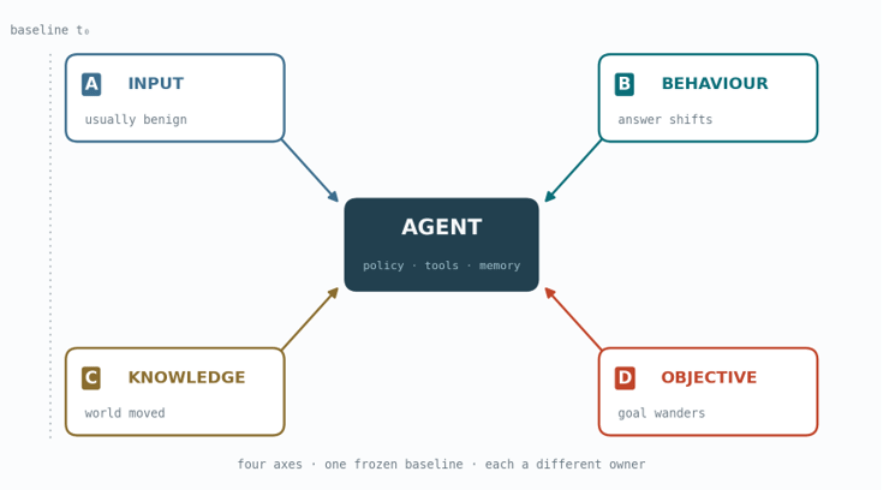
- The Four Axes
- Input Drift
Input drift occurs when the distribution of user requests changes: new topics, intents, languages, document types, or workflows. This form of drift is often benign: it may simply indicate that the user population or business process has changed.
Typical signals include embedding-distribution movement, changes in intent mix, topic entropy, language distribution, request length, and tool-selection frequency. Input drift is the closest of the four to classical data drift and can be monitored with statistical distance metrics such as Population Stability Index, Kolmogorov–Smirnov tests, KL divergence, or embedding-cluster movement. Effective AI observability practices help identify these shifts before they impact business outcomes.
Behavior Drift
Behavior drift occurs when the agent’s outputs change for identical or semantically equivalent inputs, typically because of a model-provider update, a prompt change, a routing change, a tool-policy change, or a decoding/configuration change.
Strictly, this is model drift: the model’s input-to-output function changed even though the application code did not. It is often described by analogy to concept drift, but concept drift in its original sense means a shift in the true input-to-target relationship in the world, not a swapped model, so model drift is the more precise term for the deployed-system case.
Useful monitors include golden-prompt regression tests, semantic similarity against approved outputs, output-format validation, tool-call comparison, and AI evaluation scoring for correctness, completeness, safety, and instruction adherence. These techniques are increasingly important for LLM monitoring in enterprise environments.
Knowledge Drift
Knowledge drift occurs when the external world or source of truth changes, but the agent continues to answer from stale, incomplete, or incorrectly indexed knowledge.
This is not always visible through distributional monitoring. If a policy value changes from 4.5% to 4.0%, the user input looks normal and the output looks fluent, yet the answer is wrong. Knowledge drift therefore requires direct validation against the source of truth: golden-set factual assertions, document-freshness checks, source-of-record comparison, retrieval-freshness metrics, citation validation, and claim-level groundedness evaluation.
Where no authoritative source exists for a claim, faithfulness cannot be checked by entailment. Sampling-based self-consistency, generating an answer several times and measuring whether the versions agree, flags likely fabrication without an external database and complements groundedness checks for open-ended answers. This is particularly important for organizations implementing AI governance frameworks.
Objective Drift
Objective drift occurs when the agent’s working goal diverges from the user’s intended goal during a multi-step run. It is especially important in systems that plan, retrieve, call tools, reflect, and revise across many turns.
It can arise from poor planning, over-broad retrieval, tool misuse, instruction-hierarchy failure, or indirect prompt injection from retrieved content, the last of which remains one of the leading security risks for AI applications. The final response may appear plausible even though the agent served the wrong objective several steps earlier.
This axis requires trace-level evaluation rather than message-level evaluation. Monitor intent resolution, plan consistency, tool-call accuracy, instruction-hierarchy compliance, and whether intermediate actions remain aligned with the original user request. Effective objective drift detection is a critical component of enterprise AI monitoring and governance strategies.
| Drift axis | What changes | Primary sensor | Example metric |
| Input drift | User-request distribution | Statistical monitoring | PSI, KL divergence, topic entropy |
| Behavior drift | Output for stable inputs | Regression evaluation | Golden-prompt pass rate, semantic similarity |
| Knowledge drift | Source-of-truth alignment | Groundedness & factual checks | Claim-support rate, freshness delta |
| Objective drift | Multi-step goal trajectory | Trace-level evaluation | Task adherence, tool-call accuracy |
The Core Rule: Distance Is Not Correctness
Most drift monitoring begins by asking whether the data is different from before. That is useful but incomplete. Distributional distance can detect change; it cannot determine whether an Agentic AI System remains correct, grounded, compliant, or aligned with the user’s objective.
This matters because input and behavior drift often produce measurable distributional movement, while knowledge drift and objective drift may not. A dashboard can stay green while an agent answers from a stale document, follows an injected instruction, or drifts away from the original goal during a tool-using workflow.
So, object-drift monitoring should not rely on a single metric. Each axis needs a different class of sensor:
- Input drift → distribution statistics
- Behavior drift → golden-prompt regression
- Knowledge drift → source-of-truth validation
- Objective drift → trace-level task evaluation
Organizations investing in AI observability, LLM monitoring, and AI governance should treat statistical distance as a signal of change, not as proof of correctness.
Closing Note
Agentic AI Systems do not always crash when they fail. They often degrade through silent divergence: the request mix changes, outputs shift, knowledge becomes stale, or the objective moves during execution.
Effective AI observability therefore requires axis-specific monitoring. Statistical sensors suit input and behavior drift. Source-of-truth validation is required for knowledge drift. Trace-level evaluation is required for objective drift. Combined with robust AI evaluation, these practices help organizations maintain reliable and trustworthy AI systems.
The practical rule is simple: monitor change but validate correctness. Distance can tell you that something moved. It cannot tell you whether the agent is still right.
Categories
- Accessibility solutions (3)
- AI / LLMOps (AI Observability & Monitoring) (3)
- AI & Automation (17)
- AI Governance & Responsible AI (4)
- AI Security (4)
- Android (17)
- Angular JS (1)
- API & Integration / Developer Tools (1)
- Apple (3)
- Artificial Intelligence (1)
- Artificial Intelligence (AI) (16)
- AV & Collaboration Technology (2)
- AWS Cloud Computing (2)
- AWS DMS (6)
- AWS RDS (12)
- Azure (3)
- BI & ANALYTICS (16)
- Cloud Computing & AI (5)
- Cloud Identity & Directory Services (1)
- Cloud Migration (12)
- Cloud Security & Identity Management (3)
- Company News (5)
- Continuous integration and continuous deployment (2)
- Cybersecurity (7)
- Data Analytics (12)
- Data Engineering (8)
- Data Governance & Compliance (6)
- Data Management (5)
- Data Migration (9)
- Data Quality (1)
- Data Quality & Data Governance (1)
- DBA (10)
- DevOps (1)
- Email Security (1)
- Endpoint Management / Device Management (1)
- Enterprise AI / AI Governance (1)
- Enterprise AI / AI Implementation Best Practices (1)
- Enterprise AI & Intelligent Automation (2)
- Enterprise Mobility & Security (1)
- Enterprise Software Integration / Backend Development (1)
- Enterprise Technology (1)
- Enterprise UX/UI Design (1)
- Goldengate (19)
- Google (2)
- Hadoop (3)
- HPNA (1)
- Ios (10)
- ios 10 (2)
- iPad (3)
- iPhone (3)
- Licensing (7)
- Linux (13)
- Machine Learning Solutions (1)
- Marketing Technology (1)
- Microsoft 365 (1)
- Microsoft 365 Development / APIs (1)
- Microsoft 365 Security & Compliance (4)
- Microsoft Configuration Manager (SCCM / MECM) (1)
- Microsoft Dynamics 365 (4)
- Microsoft Marketplace (1)
- Microsoft Office (5)
- Microsoft Purview (3)
- Microsoft SharePoint & Security (1)
- Microsoft Teams / Collaboration Tools (1)
- Microsoft Teams Security & Compliance (2)
- Mobile (2)
- Network Automation (5)
- Network Security Services (1)
- News (21)
- Operating System (1)
- Oracle (37)
- oracle consulting (3)
- PostgreSQL (1)
- Quantum Computing (1)
- Quickbooks (1)
- SEO (1)
- Software Development (33)
- Systems Automation (2)
- Tech (3)
- Technology (51)
- UI (13)
- Uncategorized (8)
- UX (9)
- VSTO (1)
- Web Development (1)
- Windows (9)
- wordpress (1)