

Hardening Agent Instructions: Securing the Soft Layer of Copilot Studio Governance
Enterprise adoption of low-code AI agents has moved faster than the security practices meant to contain them. Microsoft Copilot Studio lets business users assemble agents that do not merely generate text but also act, calling connectors and reading tenant data in SharePoint, Dataverse, and Exchange, often with programmatic privileges that are invisible to the citizen developer who built the agent. Within that architecture, one control deserves separate and disproportionate attention: the agent’s instructions block. As organizations increasingly focus on Microsoft Copilot Studio security, AI agent security, and enterprise AI governance, securing this layer has become a business-critical priority.
Instructions are the central directions an agent follows: they decide which tools, knowledge sources, topics, or other agents to call, how to fill tool inputs from context, and how to generate the final response. Unlike network encryption or identity-based access control, they are interpreted by a language model rather than enforced by a deterministic boundary. They are the layer over which an organization has the most authorship and the least external guarantee. This article is a focused playbook for strengthening Copilot Studio governance, reducing AI security risks, and improving prompt injection prevention strategies.
- Why Instructions Behave Differently from Every Other Control
An agent’s behavior is shaped by stacked layers of text: system prompts, developer instructions, connected data, and user input. When those layers are not clearly separated, user input can begin to influence execution logic. The model does not understand business intent or ethical boundaries; it optimizes instruction-following, and if an injected prompt sounds legitimate and aligns with an available action, it will often comply. That is the defining property of this layer: it is probabilistic. It steers the overwhelming majority of routine interactions correctly but cannot offer the categorical guarantee a cryptographic or policy control provides.
This is one of the biggest challenges in generative AI security and AI prompt security today. The risk is not theoretical. Tenable’s research team built a Copilot Studio customer-service agent and used a straightforward prompt injection to make it violate its core instructions, disclosing customer records that included credit card information and altering a stored price from one thousand dollars to zero, with no hacking skills required. Microsoft has also assigned CVE identifiers to prompt-injection flaws in its agent platform, including CVE-2026-21520, an indirect prompt-injection vulnerability in Copilot Studio. These incidents demonstrate why prompt injection attacks are now a major concern for organizations deploying enterprise AI systems.
The correct conclusion is not that instructions are unimportant. It is that they must be engineered with the same discipline applied to production code, while the residual risk is documented honestly. Microsoft’s own guidance is explicit on this point: the system treats agent instructions similarly to code, and the wrong instructions can break the system, particularly around citations and response gating. Strong AI governance frameworks and secure prompt engineering practices are therefore essential for enterprise deployments.
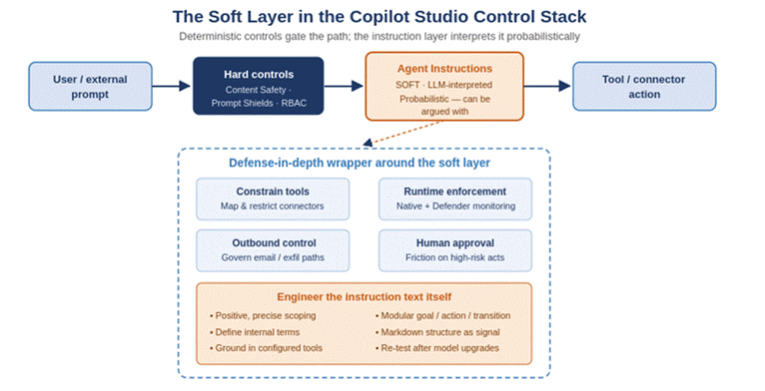
- Engineering Instructions That Resist Drift
Vague instructions create the ambiguity that adversarial prompts exploit. Microsoft’s authoring guidance converges on a small set of principles that also function as security controls because they reduce the interpretive room an attacker needs. These practices are increasingly recognized as foundational to Copilot Studio best practices and secure AI agents.
- State intent positively and precisely. Focus on what the agent should do rather than what to avoid, and use specific verbs such as ask, search, send, check, or use, supplemented with examples to minimize ambiguity.
- Decompose workflows into modular steps. Each step should carry an explicit goal, an action naming the tool to use, and a transition criterion for moving on or ending.
- Define organizational terms. Any term that is nonstandard or unique to the organization should be defined in the instructions so the model cannot substitute a generic interpretation.
- Use structure as a parsing signal. Copilot Studio accepts Markdown in the instruction field; headings, bullets, and emphasis help the model parse intent, and critical rules can be bolded as whole lines.
- Ground every instruction in configured capability. An agent cannot act on an instruction to use a tool or knowledge source it does not have; instructions must match what is actually configured.
A practical hardening technique is to isolate examples and sample dialogue into clearly demarcated sections, so the model does not confuse illustrative text with live rules. Behavioral drift across model upgrades is a related concern. Microsoft notes that periodic transitions to newer model versions can change how instructions are interpreted, making regular testing a critical part of AI risk management and AI runtime security.
Instruction Anti-Patterns and Safer Alternatives(Table)
| Anti-pattern | Safer alternative |
| Negative phrasing (“never reveal X”) | Positive scoping that defines the only permitted behavior and inputs |
| Undefined internal jargon | Explicit definitions for organization-specific terminology |
| One long unstructured block | Markdown headings and bullets that separate intent and examples |
| Instruction referencing an unconfigured tool | Instructions aligned only with configured tools and knowledge |
| Set-and-forget across model upgrades | Re-test precision-sensitive instructions after platform updates |
- Defense in Depth Around the Soft Layer
Because instruction-following is probabilistic, instructions must never be the only thing between a user’s prompt and a sensitive action. Microsoft’s zero-trust guidance recommends layering multiple probabilistic and deterministic mitigations, designing with the assumption that prompt injection attacks are inevitable and isolating untrusted content from critical inference. This is a core principle of zero trust AI security.
The most effective controls constrain what a hijacked agent can actually reach.
- Constrain the tool and connector surface. Preemptively map every agent-enabled tool to understand which systems and data stores the agent can access, then apply environment-level data policies that restrict high-risk connectors in production.
- Treat outbound channels as exfiltration paths. When an agent uses orchestration to send email, the orchestrator chooses recipient and content at runtime, meaning a successful injection could expose sensitive internal data externally. Strong governance over email connectors and connector action control is essential for Copilot Studio security.
- Add runtime enforcement, not just authoring care. Copilot Studio can combine native and Defender-integrated runtime protections that monitor prompt-injection threats and deviations from intended objectives. These protections strengthen AI security architecture when properly configured and monitored.
- Keep humans on high-risk actions. Manual approvals and audits add deliberate friction to consequential operations and are recommended safeguards for sensitive workflows involving enterprise AI governance.
These measures acknowledge an important reality across the AI security landscape: AI systems are probabilistic, not deterministic, and require ongoing supervision rather than blind trust. Indirect prompt injection remains especially difficult because the model cannot reliably distinguish user input from external content, making traditional input validation insufficient on its own.
- Governing and Validating the Instruction Layer
Hardening is not complete until it is testable and auditable. Microsoft’s guidance recommends treating instruction development as an iterative cycle: publish through a validation process that integrates Responsible AI checks, verify the agent acts according to its instructions, confirm that unexpected prompts are handled appropriately, and iterate continuously.
- Test adversarially and version like code. Exercise edge cases, long prompts, irrelevant questions, and department-specific scenarios. Because the platform treats instructions like code, organizations should build them incrementally with testing between additions so regressions can be isolated.
- Protect citations and re-validate after upgrades. Instructions should not modify system-defined citation formats that underpin grounding. Automatic model upgrades can alter interpretation, so security-sensitive instructions require scheduled re-testing.
For engineering teams, instructions are a source artifact requiring positive scoping, modular structure, grounding in real capability, version control, and adversarial regression testing. For compliance stakeholders, the instruction layer belongs in the risk register as a probabilistic control whose residual risk is mitigated by deterministic controls such as connector restriction, runtime monitoring, and human approval workflows.
Closing Perspective
The instruction block is where organizational intent meets a probabilistic system. Written carelessly, it becomes one of the softest parts of an otherwise secure stack and often the first layer attackers probe through AI agent prompt injection techniques. Written and governed with discipline, and reinforced by deterministic controls that limit blast radius, it becomes a dependable expression of policy rather than a single point of failure.
The durable posture for Microsoft Copilot Studio security is layered: engineer the instruction layer carefully, never rely on it alone, and assume injection attempts are a permanent operating condition rather than an exception. In a rapidly evolving landscape of AI compliance and governance, organizations that combine secure instruction design with strong operational controls will be better positioned to deploy scalable and secure AI systems.
Categories
- Accessibility solutions (3)
- AI / LLMOps (AI Observability & Monitoring) (3)
- AI & Automation (17)
- AI Governance & Responsible AI (4)
- AI Security (4)
- Android (17)
- Angular JS (1)
- API & Integration / Developer Tools (1)
- Apple (3)
- Artificial Intelligence (1)
- Artificial Intelligence (AI) (16)
- AV & Collaboration Technology (2)
- AWS Cloud Computing (2)
- AWS DMS (6)
- AWS RDS (12)
- Azure (3)
- BI & ANALYTICS (16)
- Cloud Computing & AI (5)
- Cloud Identity & Directory Services (1)
- Cloud Migration (12)
- Cloud Security & Identity Management (3)
- Company News (5)
- Continuous integration and continuous deployment (2)
- Cybersecurity (7)
- Data Analytics (12)
- Data Engineering (8)
- Data Governance & Compliance (6)
- Data Management (5)
- Data Migration (9)
- Data Quality (1)
- Data Quality & Data Governance (1)
- DBA (10)
- DevOps (1)
- Email Security (1)
- Endpoint Management / Device Management (1)
- Enterprise AI / AI Governance (1)
- Enterprise AI / AI Implementation Best Practices (1)
- Enterprise AI & Intelligent Automation (2)
- Enterprise Mobility & Security (1)
- Enterprise Software Integration / Backend Development (1)
- Enterprise Technology (1)
- Enterprise UX/UI Design (1)
- Goldengate (19)
- Google (2)
- Hadoop (3)
- HPNA (1)
- Ios (10)
- ios 10 (2)
- iPad (3)
- iPhone (3)
- Licensing (7)
- Linux (13)
- Machine Learning Solutions (1)
- Marketing Technology (1)
- Microsoft 365 (1)
- Microsoft 365 Development / APIs (1)
- Microsoft 365 Security & Compliance (4)
- Microsoft Configuration Manager (SCCM / MECM) (1)
- Microsoft Dynamics 365 (4)
- Microsoft Marketplace (1)
- Microsoft Office (5)
- Microsoft Purview (3)
- Microsoft SharePoint & Security (1)
- Microsoft Teams / Collaboration Tools (1)
- Microsoft Teams Security & Compliance (2)
- Mobile (2)
- Network Automation (5)
- Network Security Services (1)
- News (21)
- Operating System (1)
- Oracle (37)
- oracle consulting (3)
- PostgreSQL (1)
- Quantum Computing (1)
- Quickbooks (1)
- SEO (1)
- Software Development (33)
- Systems Automation (2)
- Tech (3)
- Technology (51)
- UI (13)
- Uncategorized (8)
- UX (9)
- VSTO (1)
- Web Development (1)
- Windows (9)
- wordpress (1)