

Data Quality Rules in Ataccama ONE: Types, Dimensions & Best Practices
DQ Rules in Ataccama ONE: A Practical Guide to Data Quality Management
What Are Data Quality Rules?
Data quality rules are the foundation of effective data quality management. In Ataccama ONE, these rules define how data is evaluated, validated, and monitored across datasets.
DQ rules allow organizations to apply data validation rules to catalog items and attributes based on defined conditions. Each rule is aligned with a specific data quality dimension, helping teams measure and improve data reliability.
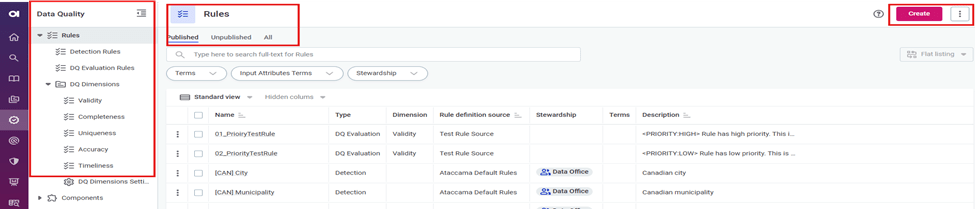
These dimensions include Validity, Completeness, Uniqueness, Accuracy, and Timeliness, forming a structured data quality framework for enterprise data governance.
Types of Data Quality Rules in Ataccama
- Detection Rules (Data Profiling Rules)
Detection rules are used for data profiling and automatic classification. They identify patterns and assign business domains to attributes.
For example:
- Validate formats such as email or phone numbers
- Match values against reference datasets
- Identify domain-specific attributes
Detection depends on:
- Rule logic (pattern or condition)
- Detection threshold (percentage match required)
These rules support data quality checks at scale and improve metadata classification.
- DQ Evaluation Rules (Data Quality Checks)
DQ evaluation rules are used to measure and monitor data quality metrics. These rules are applied to business terms and automatically extended to related attributes.
Each rule evaluates a single data quality dimension, ensuring focused and modular validation.
For example:
- Email field → format validation
- Customer ID → uniqueness check
- Mandatory field → completeness validation
This modular approach ensures scalable data governance rules and reusable logic across datasets.
Data Quality Dimensions Explained
Validity (Data Validity Rules)
Ensures that data follows the correct format and structure.
Examples:
- Is the email format valid?
- Is the date in the correct format?
Completeness (Data Completeness Check)
Ensures required fields are not empty.
Examples:
- Is the mandatory field populated?
- Are there missing values?
Uniqueness (Duplicate Data Check)
Ensures no duplicate records exist.
Examples:
- Does the Customer ID appear more than once?
Accuracy (Data Accuracy Validation)
Validates data against trusted reference sources.
Examples:
- Does the country code exist in the reference list?
Timeliness (Data Freshness Monitoring)
Ensures data is up to date.
Examples:
- Was the record updated within the expected timeframe?
How to Create Data Quality Rules in Ataccama ONE
Follow these steps to implement data quality rules in Ataccama:
- Navigate to Data Quality → Rules → Create
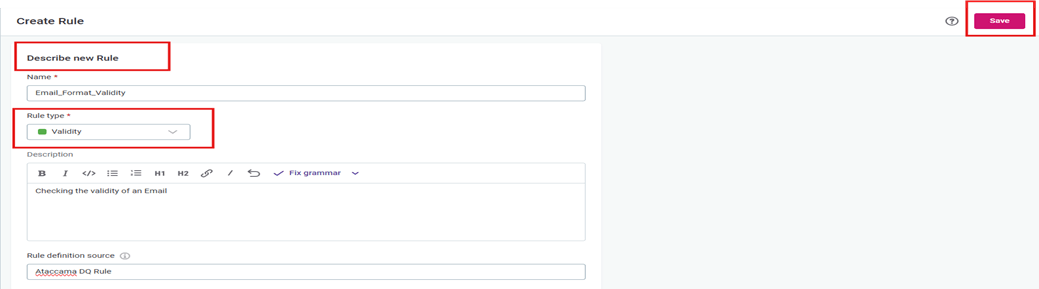
- Add rule name, description, and owner
- Define inputs and conditions in the Implementation tab
- Use:
- Condition Builder (no-code)
- Advanced Expression (custom logic)
- Test with valid and invalid data scenarios
- Publish and map the rule to a business term
This process ensures consistent data validation rules across your data ecosystem.
Best Practices for Data Quality Rules
- One rule per concern — separate rules for emptiness, format validity, uniqueness, and
referential integrity keep things modular and reusable.
- Name rules clearly — descriptive names likeEmail_Format_Validityor
Customer_ID_Uniqueness make governance easier as your rule library grows.
- Use variables for transformations — trim, round, or lowercase inputs in the Variables section
before applying conditions, so your logic stays clean.
- Always test with both passing and failing values —don’tjust test the happy path.
- Leverage AI for expression drafting — but always review and align the result type (Valid vs Invalid) manually.
- Assign scores thoughtful
Why Data Quality Rules Matter
Implementing strong data quality rules improves:
- Decision-making accuracy
- Data governance and compliance
- Operational efficiency
- Trust in analytics and reporting
With tools like Ataccama ONE, organizations can build a scalable data quality framework that ensures consistent, reliable, and actionable data.
Categories
- Accessibility solutions (3)
- AI / LLMOps (AI Observability & Monitoring) (3)
- AI & Automation (17)
- AI Governance & Responsible AI (4)
- AI Security (4)
- Android (17)
- Angular JS (1)
- API & Integration / Developer Tools (1)
- Apple (3)
- Artificial Intelligence (1)
- Artificial Intelligence (AI) (16)
- AV & Collaboration Technology (2)
- AWS Cloud Computing (2)
- AWS DMS (6)
- AWS RDS (12)
- Azure (3)
- BI & ANALYTICS (16)
- Cloud Computing & AI (5)
- Cloud Identity & Directory Services (1)
- Cloud Migration (12)
- Cloud Security & Identity Management (3)
- Company News (5)
- Continuous integration and continuous deployment (2)
- Cybersecurity (7)
- Data Analytics (12)
- Data Engineering (8)
- Data Governance & Compliance (6)
- Data Management (5)
- Data Migration (9)
- Data Quality (1)
- Data Quality & Data Governance (1)
- DBA (10)
- DevOps (1)
- Email Security (1)
- Endpoint Management / Device Management (1)
- Enterprise AI / AI Governance (1)
- Enterprise AI / AI Implementation Best Practices (1)
- Enterprise AI & Intelligent Automation (2)
- Enterprise Mobility & Security (1)
- Enterprise Software Integration / Backend Development (1)
- Enterprise Technology (1)
- Enterprise UX/UI Design (1)
- Goldengate (19)
- Google (2)
- Hadoop (3)
- HPNA (1)
- Ios (10)
- ios 10 (2)
- iPad (3)
- iPhone (3)
- Licensing (7)
- Linux (13)
- Machine Learning Solutions (1)
- Marketing Technology (1)
- Microsoft 365 (1)
- Microsoft 365 Development / APIs (1)
- Microsoft 365 Security & Compliance (4)
- Microsoft Configuration Manager (SCCM / MECM) (1)
- Microsoft Dynamics 365 (4)
- Microsoft Marketplace (1)
- Microsoft Office (5)
- Microsoft Purview (3)
- Microsoft SharePoint & Security (1)
- Microsoft Teams / Collaboration Tools (1)
- Microsoft Teams Security & Compliance (2)
- Mobile (2)
- Network Automation (5)
- Network Security Services (1)
- News (21)
- Operating System (1)
- Oracle (37)
- oracle consulting (3)
- PostgreSQL (1)
- Quantum Computing (1)
- Quickbooks (1)
- SEO (1)
- Software Development (33)
- Systems Automation (2)
- Tech (3)
- Technology (51)
- UI (13)
- Uncategorized (8)
- UX (9)
- VSTO (1)
- Web Development (1)
- Windows (9)
- wordpress (1)